

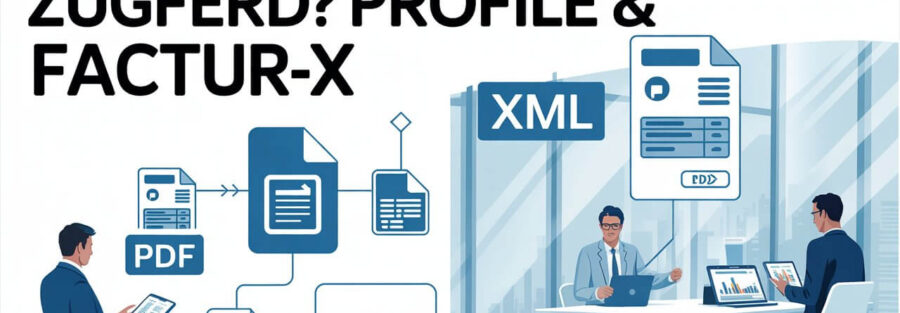
What is ZUGFeRD? Hybrid e-invoices explained
Businesses relying on paper-based invoicing face increasing operational and legal challenges. ZUGFeRD is a cross-industry format designed to make electronic invoice exchange easier. It combines a familiar visual document with data that accounting systems can process automatically.
The hybrid file contains a PDF/A-3 document and embedded structured XML. People read the PDF while software reads the invoice data. Integration can reduce re-entry and errors, but reliable master data, validation and approval controls remain necessary.
Germany’s e-invoicing requirements
For relevant domestic B2B transactions, businesses have needed to be ready to receive structured e-invoices since January 2025. Issuing requirements expand after transition provisions in 2026 and 2027, depending on turnover and statutory exceptions. See our German e-invoicing update for the distinction between receiving and issuing.
The tax administration recognises ZUGFeRD from version 2.0.1, excluding MINIMUM and BASIC WL, where the applicable requirements are met. Version number alone does not establish compliance: the chosen profile, invoice content and recipient requirements matter. Preserve the required structured original rather than only printing its visual representation.
Profiles and tax requirements
ZUGFeRD uses profiles with different amounts of structured information. Common profile names include MINIMUM, BASIC WL, BASIC, EN 16931 and EXTENDED. Historical packages also provided an XRECHNUNG profile; the available profiles depend on the release. Do not treat a historical list as the fixed profile set of every current version.
- MINIMUM and BASIC WL: Limited data sets that do not meet the German structured e-invoice definition on their own.
- BASIC: A reduced profile whose suitability must be checked against the applicable rules.
- EN 16931: The European core invoice model.
- EXTENDED: Additional information for more complex business requirements; check extensions and recipient support.
- XRECHNUNG in relevant historical packages: Designed around German public-sector rules; acceptance depends on release, XML structure and submission channel.
A document that does not qualify as a structured e-invoice is not automatically meaningless or invalid in every other context. Transition provisions and the category of invoice still need assessment.
Versions: follow published releases, not forecasts
ZUGFeRD and Factur-X evolve with validation rules, code lists and business requirements. A forecast release date is not a production specification, and publication of a newer version does not by itself prove that every earlier invoice is unlawful.
| Release family | Planning point |
|---|---|
| 2.0.1 and later | Relevant to German tax recognition, subject to profile and content |
| 2.2 and 2.3 families | Established releases; check recipient acceptance and artefacts |
| 2.4 and later | Updated specifications and validation packages |
| Current published package | Use the official FeRD release documentation and the supported implementation version |
Consult the official ZUGFeRD download page before choosing a release. Test actual documents against its profile-specific artefacts instead of relying on a version claim in marketing material.
Factur-X and cross-border compatibility
ZUGFeRD and the French Factur-X share a common technical basis and are jointly developed by German and French organisations. Their structured data uses UN/CEFACT Cross Industry Invoice.
This common basis supports interoperability, but it does not guarantee automatic acceptance of every file in every French process. Verify the matching version and profile, required national data and approved delivery arrangements. The format and the transport or reporting platform are separate choices. Our EDI standards and protocols overview explains the integration layer.
Implementing ZUGFeRD in practice
Accounting or ERP software normally generates the PDF/A-3 and embeds XML from the invoice data. Users should not need to edit XML manually for routine invoicing.
Maintain supplier, customer, tax and payment master data. Before production, test representative invoices and validate both structure and business rules. Confirm that the visual and structured information agree and that the recipient can process the chosen profile. Set up exception handling, approval and retention as part of the same workflow.
Frequently asked questions
How does it differ from XRechnung?
XRechnung is a structured XML specification without an inherent PDF view. ZUGFeRD adds a visual PDF around structured XML. A hybrid wrapper alone does not make its contents compliant with every XRechnung requirement; recipient and platform instructions remain decisive.
Are older versions still permitted?
German tax guidance recognises suitable ZUGFeRD versions from 2.0.1, excluding the limited profiles mentioned above. Technical support and acceptance may be narrower. Select a maintained, tested release rather than assuming either that all old versions are valid or that only the newest one is lawful.
What does implementation cost?
Costs depend on software, volume, integration and operations. A cloud product may include an export function, while an on-premise ERP project can require mapping, testing and operational work. Compare the full process, not only the file-generation price.
Must invoices be retained for ten years?
The general German invoice-retention period is eight years, with special rules and extensions possible. Keep at least the required structured data unchanged and retain additional tax-relevant information where necessary. A printout does not replace the electronic original.
Next step
Contact Eaglessoft to plan formats, validation and ERP integration together. This article provides general information; confirm the requirements applicable to your transactions.