
Prepare Your Business for Slovakia's New E-Invoicing Requirements
From 1 January 2027, domestic Slovak VAT payers must issue structured e-invoices for covered domestic B2B and B2G supplies, subject to statutory exceptions. Receipt readiness also applies to domestic legal entities and taxable individuals who are not VAT payers. Prepare your ERP, delivery service and invoice controls for these distinct obligations.
Get Your E-Invoicing Readiness Assessment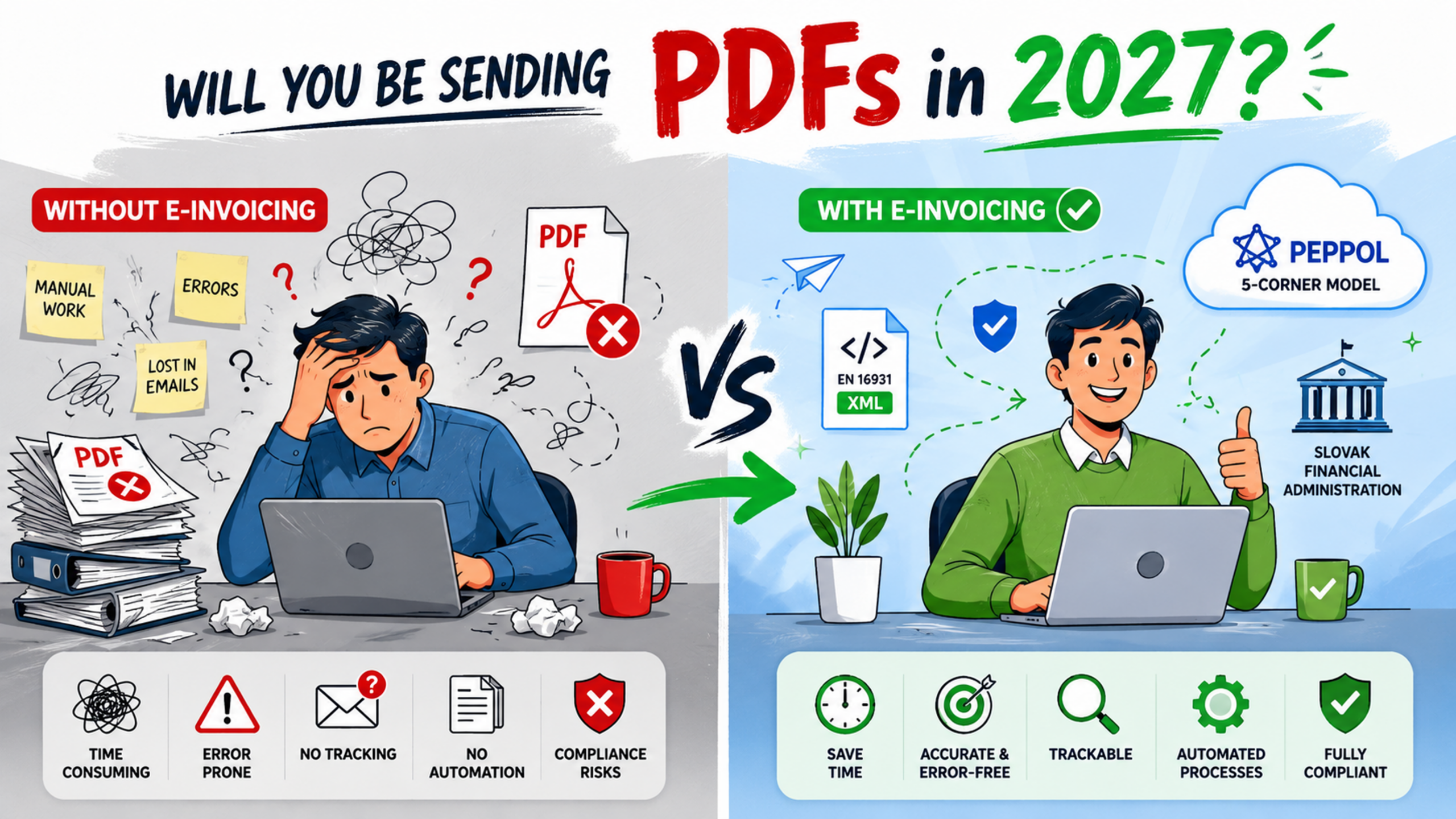
What is the PEPPOL Network?
Peppol (Pan-European Public Procurement On-Line) is an EU initiative simplifying cross-border procurement and e-invoicing.
International Network
A global network for exchanging standardized electronic documents securely.
EU Commission Initiative
Simplifies cross-border procurement for EU member states and beyond.
Document Types
Supports various documents like E-invoices, Purchase Orders, and Order Responses.
Global Reach
Coverage extends across Europe, Australia, New Zealand, and Singapore.
Standard Format BIS 3.0
Based on the EN16931 semantic data model and UBL 2.1 standard.
Peppol Access Point
A certified service provider connecting your company to the global Peppol network.
PEPPOL Interoperability Models
4-Corner Model vs 5-Corner Model
4-Corner Model

5-Corner Model (Slovakia)

Your Digital Postman for E-Invoicing
Connect your ERP and accounting system through a Digital Postman registered for Slovakia, directly or via its intermediary. Check the national register as well as Peppol connectivity.
A configured Digital Postman supports invoice validation, delivery and statutory data reporting. Agree responsibilities, authorisation and error handling with your provider.
End-to-End Data Flow & Workflows
Seamless integration for both incoming and outgoing e-invoicing documents.
AR Workflow - Outgoing Documents
(Format Conversion, Validation)
AP Workflow - Incoming Documents
(Validation, Monitoring)
Slovakia E-Invoicing Timeline
Key milestones in Slovakia's transition to mandatory e-invoicing.
Legal framework and preparation
The 2026 transition period supports preparation for the domestic obligations effective from 1 January 2027.
2026
Voluntary B2B Testing
Voluntary implementation is available from the second quarter of 2026. Test sending, receiving, validation and integration with your provider.
2027
Domestic B2B / B2G obligations
From 1 January 2027, covered domestic supplies by domestic VAT payers require structured e-invoices. Legal entities and taxable individuals must also be ready to receive them, including non-VAT payers.
Cross-border phase
The Financial Administration’s roadmap anticipates a cross-border phase from 1 July 2030. This is separate from the domestic 2027 start; follow the applicable cross-border and ViDA rules.
3 Steps to Peppol E-Invoicing
Simple implementation process for your business.
Choose a registered Digital Postman
Check the Slovak register, select the provider on the Financial Administration portal and conclude the service agreement. An ERP connection alone does not complete this selection.
Integrate with Accounting System
Integrate Peppol with your existing accounting system to ensure compatibility and process compliant invoices.
Send, Receive & Track
Send and receive compliant e-invoices seamlessly while tracking key metrics and monitoring the process.
Eaglessoft E-Compliance Solutions
Compliance. Simplified. Globally.
eDocSuite SAP Add-on
End-to-End E-Compliance directly inside SAP.
- SAP ECC & S/4HANA users
- Large enterprises
- Complex SAP environments
DocNaut Platform
API-Driven Compliance Platform supporting Peppol, format conversion, and validation.
- Microsoft Dynamics, Oracle, NetSuite
- Local ERP systems
- Custom-built software
Invocit App
A simple and intuitive cloud-based app to create, send, and manage e-invoices.
- SMEs & Freelancers
- Growing businesses
- Fast e-invoicing setup