

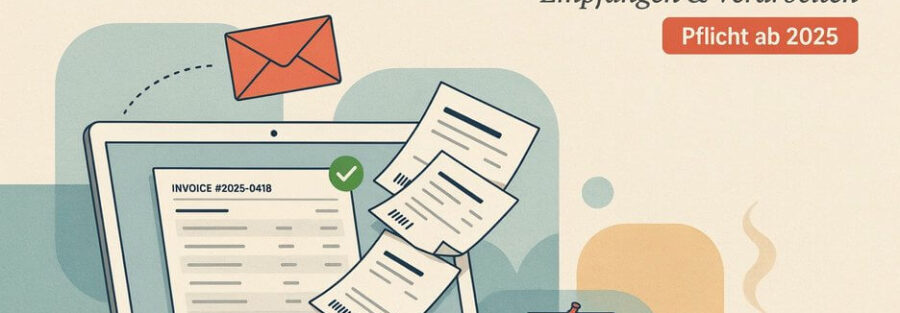
Receiving and processing e-invoices: Germany’s receipt requirements from 2025
For relevant domestic B2B transactions, German businesses have needed to be ready to receive structured e-invoices since January 2025. Receipt, readable display, validation, accounting and retention are related tasks, but they are not the same thing.
Key points
- Receipt readiness is separate from later issuing transition deadlines.
- A structured e-invoice contains machine-readable invoice data.
- XRechnung uses XML; suitable ZUGFeRD profiles combine PDF and embedded XML.
- An ordinary PDF is another invoice type, not a structured e-invoice.
- The structured part of a hybrid invoice is decisive where it differs from the visual data.
- Scope and statutory exceptions still apply; avoid the claim that every invoice without exception must be electronic.
Who needs to receive e-invoices?
The domestic B2B framework concerns the relevant transactions between businesses established in Germany under the applicable rules. A German VAT registration alone is not always equivalent to domestic establishment. Private consumers are not generally covered by this B2B mandate.
Businesses using the German small-business regime may be exempt from structured issuing while still requiring receipt readiness. Ask your adviser when establishment, exempt supplies or a specific exception is unclear.
Structured invoices and other invoices
A XRechnung is an XML document requiring a viewer for convenient human reading. ZUGFeRD in suitable versions and profiles includes both a PDF view and structured data. An emailed PDF without appropriate embedded data remains an unstructured invoice.
| Format | Structure | Human view | Typical process |
|---|---|---|---|
| XRechnung | XML | Viewer | Structured public-sector and business exchange |
| ZUGFeRD | PDF/A-3 and embedded XML | PDF view | Mixed visual and automated exchange |
The recipient’s technical requirements and the actual invoice profile matter. Check both syntax and business content rather than treating a file extension as proof of compliance.
Receipt and issuing timetable
| Period | Position for relevant domestic B2B transactions |
|---|---|
| From January 2025 | Receipt readiness |
| 2025–2026 | General issuing transition provisions |
| From January 2027 | Issuing requirement generally expands above €800,000 prior-year turnover |
| Through December 2027 | Extension generally available at or below that threshold; special EDI rules need separate consideration |
| From January 2028 | Wider issuing requirement, subject to exemptions |
Paper and other electronic invoices have different consent conditions during the transition. Do not assume that receipt readiness forces every supplier to issue structured invoices before its own applicable deadline.
Exceptions
Small-value invoices up to €250 gross, qualifying passenger tickets, specified exempt transactions and other statutory scope exclusions need separate assessment. Such documents can remain valid in other permitted forms. The obligation to keep adequate accounting evidence remains.
Receiving channels
For the act of receiving, an email mailbox can be sufficient according to the German tax administration FAQ. Other channels include Peppol and supported supplier or public-sector portals.
A mailbox does not by itself provide the complete validation, approval and retention process. Define how documents are captured, checked and passed to the accounting system, including duplicates and delivery failures.
Reading and validating XRechnung
A viewer turns structured XML into a readable presentation; the tax administration also provides a viewer through ELSTER. A suitable ZUGFeRD document already includes a PDF view, but its embedded data still needs checking.
Validation can detect XML syntax errors, missing required business data and inconsistent calculations. Keep the validation result where useful as supporting evidence. A technical result does not decide every VAT or commercial question and does not replace the invoice itself.
Automating incoming invoices
- Collect documents from the supported channels.
- Read structured data directly; use OCR only where appropriate for other document types.
- Validate syntax, business rules, required fields and calculations.
- Check duplicates, suppliers, order references and accounting assignments.
- Route approvals and exceptions by responsibility and amount.
- Post to the ERP and retain the required original and audit information.
Straight-through processing can be appropriate for controlled repeat scenarios. It requires reliable master data, integration and exception controls; it is not a reason to remove necessary approval or fraud checks.
GoBD and retention
The general German invoice-retention period is eight years, with special rules and extensions possible. At least the required structured part must remain unchanged in its original form. Retain other information where required, including tax-relevant additions in a hybrid invoice.
A printout is not a substitute for XML. Assess integrity, retrieval, availability, access and procedural documentation across the actual storage process. An unmanaged mailbox or folder may be inadequate for the wider process, but the storage product name alone does not determine compliance. A validation or storage defect does not automatically establish loss of input VAT deduction in every case.
Five steps to receipt readiness
- Create a clearly communicated invoice receiving address and suitable network connection where needed.
- Provide viewing and validation for the relevant profiles.
- Define checking, matching, approval, posting and exception handling.
- Implement controlled retention of the structured original and required supporting material.
- Update procedures, train staff and inform suppliers.
Common mistakes
Printing and losing XML, treating a mailbox as the entire archive, booking without appropriate checks, neglecting ERP master data and postponing receipt capability all create avoidable operational risk.
Frequently asked questions
Is a PDF an e-invoice?
Not if it is only an ordinary visual file. A suitable hybrid PDF with structured XML is different.
Is email enough?
It can provide a receiving channel. You still need a workable process for reading, checking, accounting and retention.
What happens if the invoice is not compliant?
Investigate the defect, transition or exception and correction options. Rejection or tax consequences depend on the actual circumstances; they should not be asserted automatically.
How long should I retain it?
Generally eight years for German invoices, with special rules and extensions. Confirm the exact starting point and scope with your adviser.
Next step
Eaglessoft can support receipt, validation and integration through the Invocit e-invoicing portal and Docnaut ERP integration platform. Book a demo to plan the complete process. This is general information; transaction-specific rules require individual assessment.