
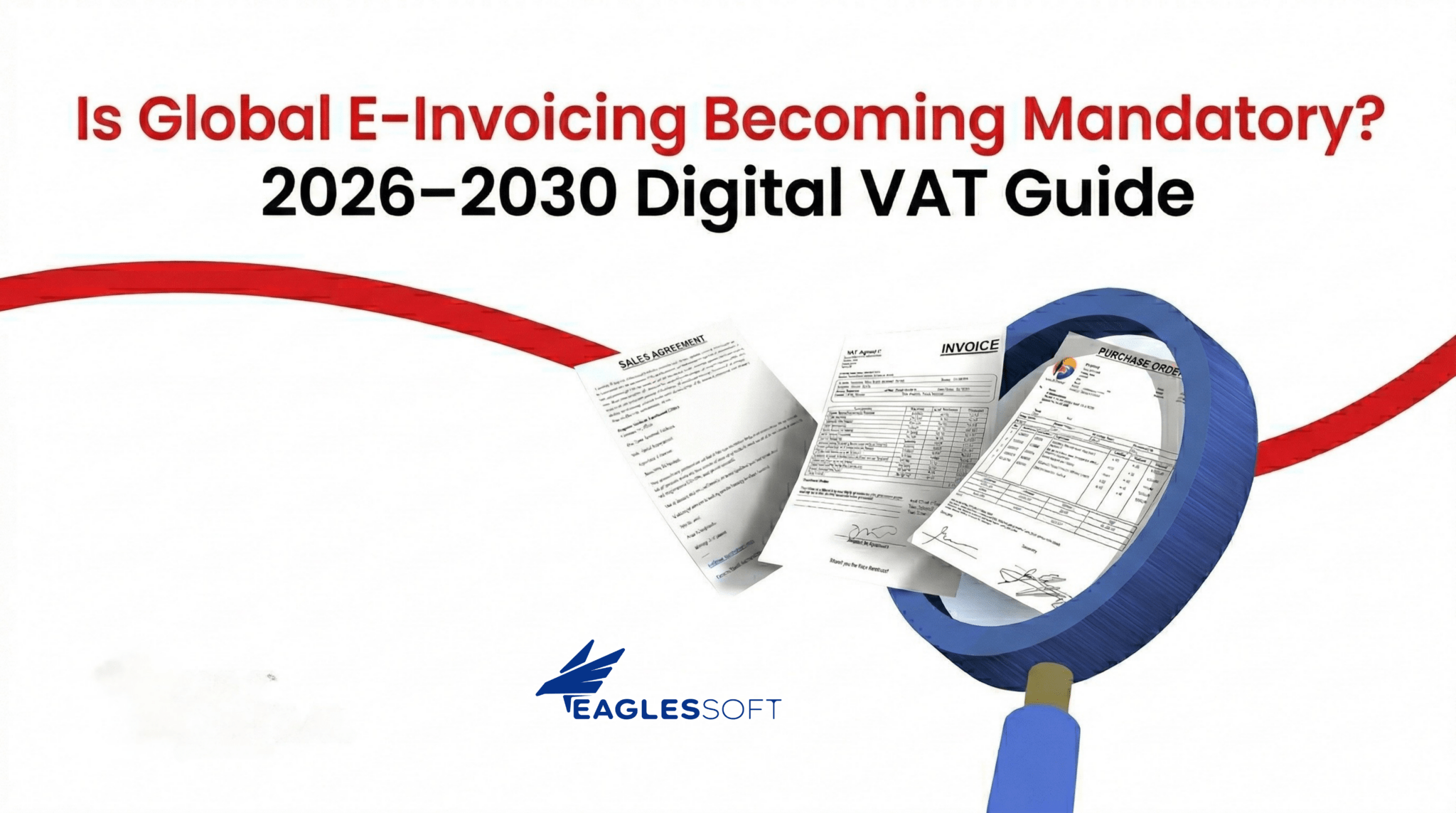
Is Global E-Invoicing Becoming Mandatory? 2026–2030 Digital VAT Guide
Over the past few months, regulatory announcements across Europe and the Middle East have significantly increased global search interest around mandatory e-invoicing, clearance models, and digital VAT reporting.
At Eaglessoft, we help businesses navigate this transformation with scalable, automated, and cross-border compliant e-invoicing solutions.
This guide answers the most critical questions companies are asking in 2026:
- Which countries are making e-invoicing mandatory?
- What is a Clearance (CTC) model?
- Is ERP integration required?
- Is Peppol used only in Europe?
- Why is 2027 a turning point?
- Are PDF invoices still valid?
Which Countries Are Making E-Invoicing Mandatory?
Global momentum is accelerating. Recent regulatory developments include:
 Germany
 Germany
- Mandatory B2B e-invoicing will begin January 1, 2025 (receiving obligation)
- Structured EN 16931-compliant invoices required
- Full digital reporting roadmap under discussion for coming years
Spain
 Spain
Spain- B2B e-invoicing mandate under the Ley Crea y Crece framework
- Implementation timeline progressing toward phased rollout
United Kingdom
 United Kingdom
- HMRC launched a public consultation on real-time digital reporting and potential future e-invoicing frameworks (2025 discussions ongoing)
United Arab Emirates
 United Arab Emirates
- Pilot phase in 2026
- Phased mandatory rollout beginning 2027
Malaysia
 Malaysia
- MyInvois mandate postponed
- Full mandatory implementation expected 2027
North Macedonia
 North Macedonia
- Clearance model effective 2026
Slovakia
 Slovakia
- Mandatory structured B2B & B2G e-invoicing from January 1, 2027
France
 France
- Mandatory B2B e-invoicing and e-reporting via PDP (Plateforme de Dématérialisation Partenaire) model
Ireland
 Ireland
- EU-aligned phased rollout expected between 2028–2030
The direction is clear: structured electronic invoicing is replacing traditional formats worldwide.
Eaglessoft supports businesses across these jurisdictions with fully compliant, cross-border solutions aligned with EU and local standards.
What Does This Mean for Businesses?
Most modern frameworks now require:
- Structured XML invoice formats
- EN 16931 compliance (European semantic standard)
- UBL or CII XML structures (technical implementations of the standard)
- Real-time or near-real-time tax reporting
PDF and paper invoices are increasingly treated as visual representations only — not legally sufficient formats for tax compliance.
Our platform ensures invoices are:
- Structured
- Machine-readable
- Legally compliant
- Audit-ready
What Is a Clearance (CTC) Model?
Clearance (Continuous Transaction Controls) requires invoices to be validated or reported to the tax authority before or at the moment of issuance.
Unlike traditional invoicing, the flow changes from:
Supplier → Customer
to:
System → Tax Authority → Buyer
Implementation models vary by country:
- Centralized validation platforms
- Certified transmission intermediaries
- Accredited Service Providers (ASPs)
What Is an ASP?
An Accredited Service Provider (ASP) is a certified intermediary authorized by tax authorities to transmit, validate, or process structured e-invoices on behalf of businesses.
Many clearance systems require companies to connect via approved ASPs instead of direct submission.
Eaglessoft provides clearance-ready infrastructure and certified integration capabilities where required.
Is ERP Integration Really Required?
Yes — modern e-invoicing cannot operate manually.
Today’s mandates require:
- Structured XML generation
- API-based real-time data exchange
- Digital signatures (where required)
- Peppol Access Point connectivity
- Automated validation workflows
Manual PDF generation is no longer scalable or compliant.
Eaglessoft delivers seamless ERP integration with API-driven automation, reducing compliance risk and operational burden.
Is Peppol Used Only in Europe?
Peppol originated in Europe but is no longer limited to the EU.
Widely adopted in:
- Ireland
- Slovakia
- France (indirectly aligned with EU standards)
- Germany (EN 16931 framework compatibility)
Expanding beyond Europe:
- Singapore
- Australia
- New Zealand
- Parts of the Middle East (alignment discussions ongoing)
Peppol enables:
- Standardized EN 16931 invoice exchange
- Secure cross-border transmission
- Automatic trading partner discovery
You likely need Peppol integration if:
- You trade within the EU
- You operate in multiple European countries
- You conduct B2G transactions
- You want standardized cross-border invoice exchange
Eaglessoft provides plug-and-play Peppol Access Point integration to ensure secure international compliance.
Why Is 2027 a Critical Year?
2027 represents a major convergence point in global VAT digitization:
- UAE – Mandatory rollout phase
- Slovakia – Mandatory structured B2B & B2G e-invoicing
- Malaysia – Expected full enforcement
- France – Ongoing structured rollout
- Germany – Transition toward fully structured B2B ecosystem
For multinational companies, 2025–2026 is the preparation window.
Waiting until mandates go live creates compliance, IT, and operational risks.
Are PDF Invoices Becoming Invalid?
In many jurisdictions:
- PDF = visual copy only
- XML = legal compliance layer
- Machine-readable format = mandatory for VAT reporting
In clearance-based systems, PDF alone is insufficient for B2B compliance.
Eaglessoft ensures invoices are:
- Structured
- Digitally traceable
- Legally valid
- Audit-compliant
The Four Major Global Trends in Digital VAT
Structured XML Standards Are Becoming the Norm
 Structured XML Standards Are Becoming the Norm
EN 16931 defines the semantic standard.
UBL and CII are XML structures built to comply with that standard.
Unstructured formats are being phased out.
Real-Time VAT Reporting Is Expanding
 Real-Time VAT Reporting Is Expanding
Tax authorities demand transactional visibility, reducing VAT gaps and fraud risks.
Platform & Intermediary Models Are Growing
 Platform & Intermediary Models Are Growing
PDPs, ASPs, certified intermediaries, and government platforms are increasingly mandatory.
Multi-Country Compliance Is Now Essential
 Multi-Country Compliance Is Now Essential
A local-only solution is no longer enough for multinational operations.
What Should Your Organization Do Now?
- Conduct multi-country compliance impact analysis
- Upgrade ERP systems for XML & API readiness
- Prepare for clearance, Peppol, and ASP-based models
- Establish tax–IT collaboration
- Monitor pilot programs and regulatory updates
Eaglessoft provides end-to-end global e-invoicing infrastructure, including:
- Multi-country compliance platform
- Clearance-ready architecture
- Peppol Access Point services
- ERP-agnostic API integration
- Real-time VAT reporting capabilities
Final Thoughts: Digital VAT Is No Longer Optional
Search trends clearly show rising interest in:
- “When will e-invoicing become mandatory?”
- “What is clearance?”
- “Do we need Peppol?”
- “What happens in 2027?”
The answer is consistent across jurisdictions:
Digital VAT transformation is accelerating — and becoming mandatory.
Organizations that act early will reduce risk, improve automation, and gain operational efficiency.
Choose the right strategy.
Automate compliance.
Turn regulation into competitive advantage — with Eaglessoft.