
Peppol and Compliance: Understanding the Boundaries of Responsibility
Where Does Your Responsibility Begin and End?
Many companies assume that once they connect to Peppol, compliance is handled automatically. In reality, compliance responsibilities extend beyond simply connecting to the network.
Doing business globally is exciting, but managing international invoicing is becoming a major headache for growing companies. Today, governments worldwide are fundamentally changing how they collect tax data. They no longer rely solely on periodic tax reporting; instead, many are moving toward real-time or near real-time visibility into business transactions.
To make this digital invoicing smoother, many companies use Peppol—a secure, international network that allows different software systems to talk to each other and exchange invoices safely.
However, using Peppol doesn’t automatically solve your local tax problems. While Peppol provides the international highway, every country’s tax authority sets up its own digital checkpoints and unique local rules.
How do we stay compliant with varying local rules without slowing down our operations? And legally, where does our responsibility end and our service provider’s begin?
The Problem: One Global Network, Too Many Local Rules
Peppol uses a standardized invoice format. The challenge is that individual countries add their own mandatory layers on top of it. For example, Germany applies XRechnung-specific business rules, the Netherlands uses NLCIUS requirements, and other countries introduce their own mandatory identifiers, validation rules, and reporting obligations on top of the common Peppol framework. A data field (like a specific project code or local tax ID) that is optional in one country might be strictly mandatory in another. If that field is missing, the invoice is rejected.
Furthermore, countries such as Poland and Romania have adopted centralized e-invoicing models. In these frameworks, invoices must be submitted through government-controlled platforms as part of the compliance process rather than being exchanged solely between trading partners.
Mapping the Lines of Responsibility: Who is Accountable?
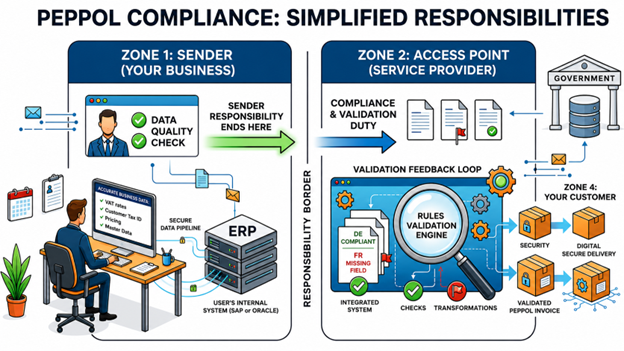
When an invoice is rejected, delayed, or triggers a compliance issue, the first question is often: who is responsible? The answer depends on which part of the process failed. In a modern e-invoicing ecosystem, responsibilities are shared between the sender and the service provider.
Zone 1: Your Company (The Sender) — As the sender, you are responsible for the business content of the invoice. This includes ensuring that customer information is correct, tax identifiers are valid, VAT treatment is appropriate, prices and calculations are accurate, and all mandatory business data is available.
While service providers can help validate technical requirements, they cannot determine whether your commercial or tax data is correct. The accuracy of the information generated by your ERP or financial system remains your responsibility.
Zone 2: Your Service Provider (The Access Point) — Once the invoice leaves your system, the Access Point takes over. Its role is to ensure that the document meets the applicable technical requirements and can be successfully delivered to the intended recipient. This typically involves validating the invoice against the relevant technical specifications before transmitting it through the network.
Many Access Point providers do much more than technical validation and document delivery. They help businesses navigate local requirements by offering services such as document transformation, country-specific validation, regulatory monitoring, and integrations with government-mandated e-invoicing platforms.
As e-invoicing regulations continue to evolve, choosing the right provider becomes increasingly important. The difference between a provider that simply delivers compliant documents and one that actively helps manage regulatory complexity can have a significant impact on how efficiently a business operates across multiple jurisdictions.
How to Protect Your Business: 3 Strategic Steps
Let the Experts Handle the Translation:
Do not try to program every country’s specific tax rules directly into your core internal system or ERP.Instead, ensure your system produces a rich and complete dataset containing all relevant business information. Whenever possible, leave the heavy lifting—the translation, local formatting, and country-specific compliance requirements—to your invoicing service provider.Lock Down Your Vendor Contracts (SLAs):
Tax laws and digital validation rules changefrequently. Since validating these rules is the service provider’s responsibility, your contract with them must state that they are required to keep their system updated with the latest country laws.Demand Real-Time Alerts:
Even though your provider handles the technical validation, your team needs immediate feedback. If your service provider blocks an invoice because it fails a specific country’s check, your finance team needs to know instantly so they can fix the underlying data.
Conclusion
Peppol is a fantastic tool for moving data across borders, but it does not erase local tax laws. By understanding the golden rule of e-invoicing—business data remains your responsibility, while technical validation and delivery are typically handled by your service provider—your company can safely expand into new markets without introducing unnecessary compliance risks.