


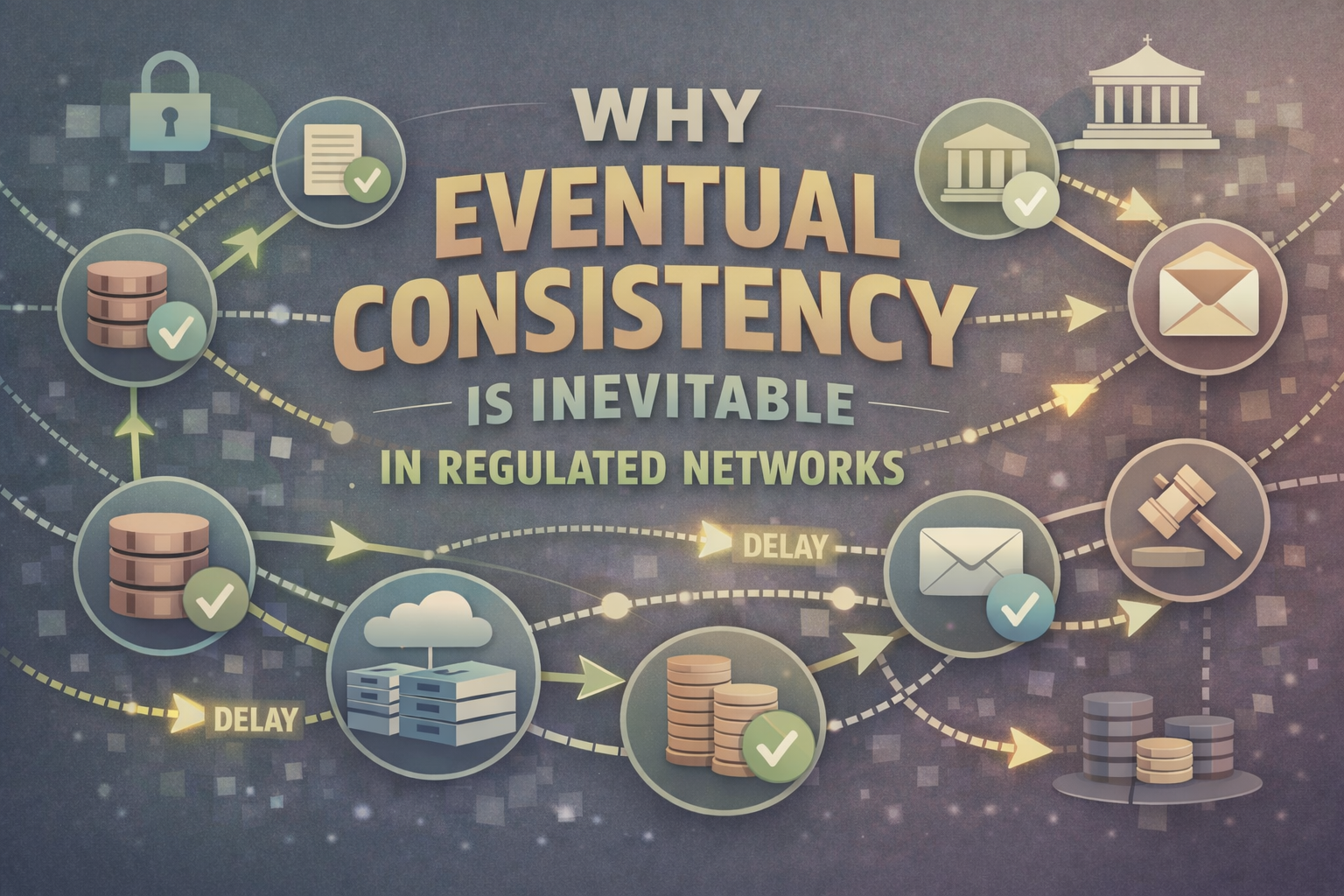
Why Eventual Consistency Is Inevitable in Regulated Networks
One of the most common frustrations for teams working with regulated networks is this:
The rules are clear.
The standards are defined.
Yet systems do not behave as “instantly correct” as expected.
This is often perceived as a problem.
However, in regulated networks, eventual consistency is not a weakness — it is a deliberate outcome.
This article focuses on understanding why, in regulated networks, the goal is not immediate consistency, but correctness achieved over time.
 What Does a Regulated Network Mean?
 What Does a Regulated Network Mean?
A regulated network means:
- Participation is controlled
- Roles, authorities, and responsibilities are clearly defined
- Rules are centrally established
but
- implementation
- performance
- process flow
- technical details
are not enforced by a single central authority.
In other words:
Regulated ≠ Centralized
Networks like PEPPOL are a good example of this structure,
but this approach is not unique to PEPPOL.
There Is No Single “Correct Moment”
In regulated networks, a transaction:
- does not complete within a single system
- does not conclude with a single actor
- does not end with a single control
A document:
- is sent
- is received
- passes preliminary checks
- is processed by different systems
- undergoes deeper validations
- eventually reaches a final outcome
All of these steps cannot run at the same time.
Therefore, the question:
“Is it correct right now?”
does not have a single, universal answer.
This reality is the foundation of eventual consistency.
Correctness Is More Valuable Than Speed
The priority of regulated networks is:
- not to respond quickly
- but to fulfill responsibility correctly
Some validations are:
- expensive
- time-consuming
- dependent on external systems
- legally consequential
Making these checks synchronous at all times:
- slows systems down
- introduces network-wide latency
- becomes operationally unsustainable
That is why regulated networks often follow this model:
accept first
verify later
This approach produces eventual consistency — but it keeps the system viable.
The Central Authority Cannot Enforce “How”
In regulated networks, the central authority:
- defines which rules must be applied
- determines who assumes which roles
But it cannot dictate:
- when a check must run
- how fast a response must be returned
- in what order controls must be applied
Because:
- countries differ
- institutions differ
- technical infrastructures differ
- legal obligations differ
This flexibility inevitably creates:
- timing differences
- flow differences
- behavioral differences
But it still guarantees that rules are eventually enforced.
Errors Cannot Always Be Detected Immediately
In regulated networks, some errors:
- are discovered after processing has begun
- emerge during deeper validation stages
At that point, completely stopping the system:
- may be costly
- may be operationally impossible
- may even be legally prohibited
Therefore, systems:
- allow progress
- handle errors later
- correct outcomes retroactively
This approach naturally produces eventual consistency.
Trust Does Not Come From Instant Consistency
There is a critical misconception:
“Trust = every message is immediately correct”
In regulated networks, trust comes from:
- identity verification
- clearly defined accountability
- traceability
- auditability
- enforcement mechanisms
In other words, trust comes not from instant correctness,
but from the impossibility of hiding mistakes.
An error:
- may be detected late
- but it does not disappear
- it leaves a trace
- it can be explained
This structure is fully compatible with eventual consistency.
The Real World Is Already Eventual
In fact, regulated networks are the digital reflection of the real world.
- Banking transactions
- Commercial processes
- Legal decisions
- Tax and accounting flows
none of these operate with “instant absolute correctness.”
Regulated networks bring this reality into digital systems.
Architectural Implications
Once these realities are accepted, the integration approach changes.
In regulated networks:
- integration is a process, not a single call
- state tracking is centralized
- asynchronous flows are natural
- retry and replay are inevitable
- observability becomes critical
Eventual consistency is not a byproduct of this architecture —
it is its natural outcome.
Conclusion
In regulated networks, eventual consistency is not:
- a shortcoming
- a weakness
- a temporary workaround
It is the inevitable combination of distributed responsibility, legal requirements, and technical realities.
The goal in regulated networks is:
not to be instantly correct,
but to ensure that nothing remains incorrect over time.
That is why eventual consistency is inevitable.
F.M. Arslan