
Sovereign Cell Architecture: Designing Data-First Systems for Compliance and Control
Sovereign Cell Architecture: Designing Systems Around Regulation
Looking at this topic purely as a technical challenge creates the wrong perspective from the very beginning.
Let’s start with a short story.
A SaaS company operating across Europe had been scaling successfully for years, proudly claiming a “multi-region” architecture. Everything seemed fine—systems were running, customers were growing, and the product was evolving.
Until the audit arrived.
A simple question changed everything:
Is German customer data actually in Germany?
The team confidently answered yes—after all, they had a deployment in Germany.
But a deeper inspection told a different story.
Backups were stored in the US. Logs were centralized. Support teams across different countries had access to the data.
Technically, the system was working.
From a regulatory perspective, it was not compliant.
And from that moment on, everything changed.
Most companies don’t redesign systems because they fail to scale—they redesign them because they fail compliance.
This is not about performance.
It’s about where data lives, who can access it, and whether your architecture can survive an audit.
It’s Not About Splitting Systems — It’s About Splitting Data
The most common mistake is trying to split the system.
The real problem is not the system.
It’s the data.
Imagine two customers using the same product—one in Germany, one in Turkey. From the outside, their experience is identical: same login, same interface, same workflows.
But behind the scenes, they should exist in completely different worlds.
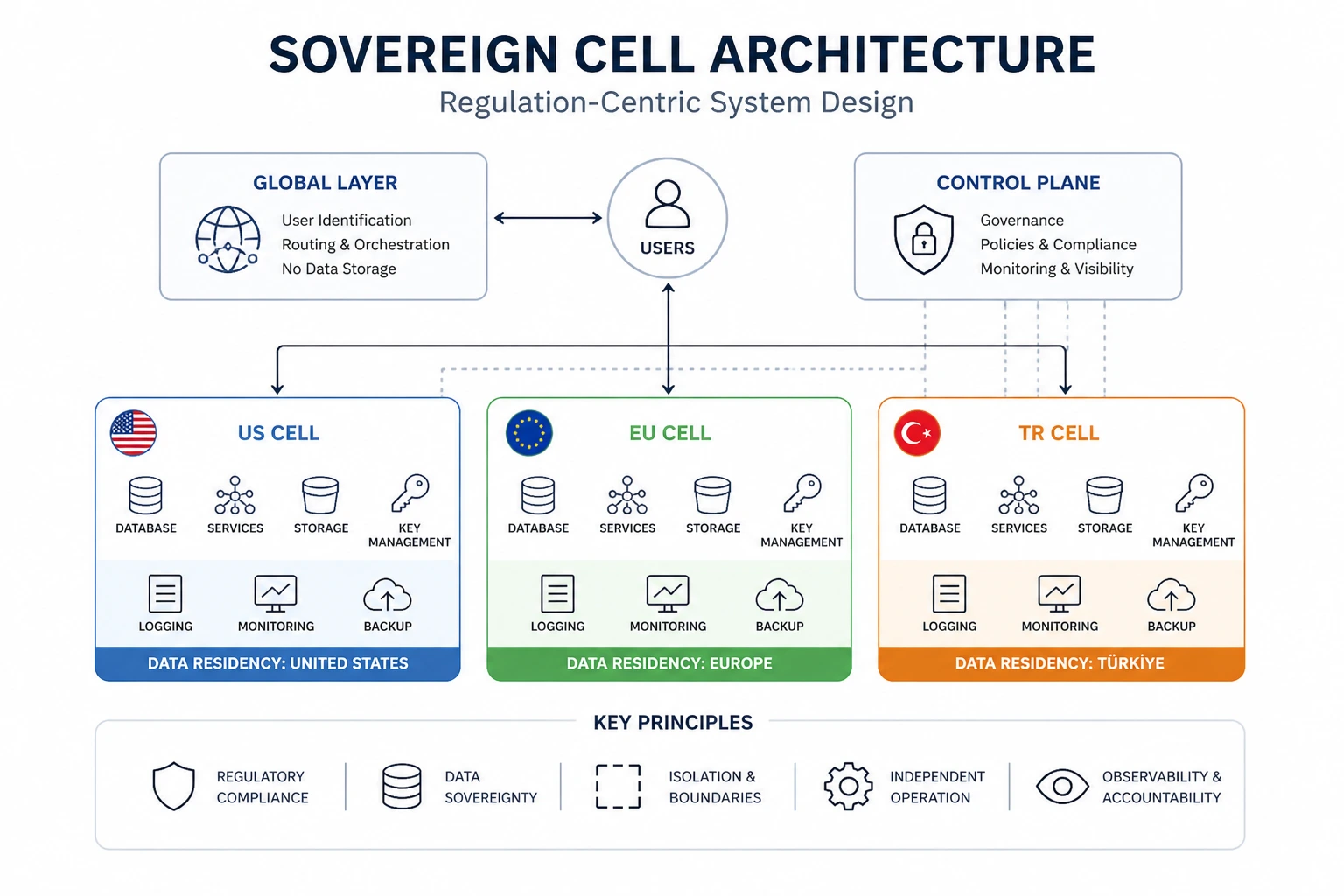
That’s what a sovereign cell architecture enforces.
Each cell is an independent system:
- Its own database
- Its own services
- Its own logging and backup
- Its own key management
The global layer does not store data.
It only routes requests to the correct cell.
Multi-Region vs Sovereign Architecture
These two are often confused—but they solve different problems.
- Multi-region is about performance and availability
- Sovereign architecture is about control and compliance
The real question is simple:
Where does your data actually live?
In many systems, data starts in one region—but spreads across others:
- Backups in another country
- Logs in centralized systems
- Cache layers elsewhere
- Human access across borders
Data is not just technically distributed—it is organizationally distributed.
And regulation asks one simple question:
Does the data stay within its defined boundaries?
Most systems cannot confidently answer this.
Isolation Is a Spectrum
Isolation is not binary—it’s a spectrum.
- Shared systems → lower cost, higher risk
- Regional separation → better control
- Cell-based isolation → strongest model, highest cost
The biggest mistake?
Assuming the most isolated architecture is always the best.
The right approach is:
Design for the level of isolation you actually need.
Why Traditional Architectures Fall Short
Classic approaches don’t fully solve this problem.
- Monoliths scale poorly globally—every region requires full duplication
- Microservices increase flexibility but often blur data boundaries
- Multi-region setups distribute systems—but not necessarily control data
Many teams stop here because the system “works.”
But the real test is always the audit.
Everything Comes Down to One Thing: Boundary Design
At its core, this entire topic is about one concept:
How you define boundaries.
Sovereign cell architecture is not about splitting services.
It’s about controlling data boundaries.
This is critical not just for compliance—but for risk management.
When something fails, it should not impact the entire system.
It should only affect a single cell.
This is how you reduce blast radius.
The Real Challenge: Not Technical, But Financial
In theory, the model is clear.
In practice, it becomes complex.
There are two layers:
Global Layer
- Routes requests
- Identifies user location
- Does not store data
Cell Layer
- APIs
- Services
- Databases
- Storage
- Logging
- Key management
The biggest challenge is not engineering.
It’s cost.
Logging, monitoring, tracing, and backups become expensive when duplicated per region.
But centralizing them breaks compliance.
The real challenge is finding the balance.
The Golden Rule
When a request enters the system:
- It is resolved by the global layer
- Routed to the correct cell
- Fully processed locally
Raw data never crosses borders.
Only anonymized or aggregated data may leave.
When NOT to Use This Architecture
Not every system needs this.
For:
- Small-scale products
- Single-country operations
- Simple applications
This architecture adds unnecessary complexity and cost.
Common Mistakes Teams Make
Teams implementing this approach often:
- Store data in the global layer
- Allow unrestricted support access
- Store backups in other countries
- Centralize key management
And still believe they are compliant.
Until the audit proves otherwise.
A Simple Test
Ask yourself:
If one country’s system goes completely offline…
Do other countries continue operating?
If yes—you are on the right path.
Final Thought
Splitting services is easy.
Designing data boundaries is the real architecture.
And that’s where the real competitive advantage lies.
References
- https://learn.microsoft.com/en-us/azure/architecture/guide/multitenant/approaches/overview
- https://docs.aws.amazon.com/wellarchitected/latest/reducing-scope-of-impact-with-cell-based-architecture/reducing-scope-of-impact-with-cell-based-architecture.html
- https://architectelevator.com/cloud/hybrid-cloud