
Global e-invoicing in SAP: end-to-end invoice processes with eDocSuite
Sending or receiving an electronic invoice is only one part of the e-invoicing process. The real challenge is to integrate invoice data reliably into existing SAP workflows, check it from a business perspective and process it automatically across borders and different formats.
Which purchase order belongs to an incoming invoice? How are suppliers and line items matched? How does outgoing invoice data reach the required target format? And how can employees see where a document was processed successfully or where an error occurred?
At Eaglessoft, these questions guided the development of eDocSuite. The solution supports various electronic business documents, including quotations, sales orders, delivery notes and invoices. This article focuses on e-invoicing: our approach to global, SAP-integrated processes for incoming and outgoing invoices.
A common data model as the foundation
Companies work with different SAP systems, master data and business processes. They also face different requirements for electronic invoices in individual countries.
If every new requirement is implemented as a separate interface, recurring tasks can arise: data must be extracted, mapped and prepared for another format again.
With eDocSuite, we therefore take an approach that works across countries. We create a common, country-independent data model from the SAP data. It forms the basis for the subsequent transformation into the required e-invoicing format.
The extraction of SAP data and its preparation for the target format are thereby separated. Existing data preparation can be reused, while country-specific and format-specific requirements can be added selectively.
The characteristics of each country remain relevant. The common data model provides a reusable foundation; the appropriate mapping and validation rules address the requirements of the target process.
Incoming invoices: from receipt to SAP processing
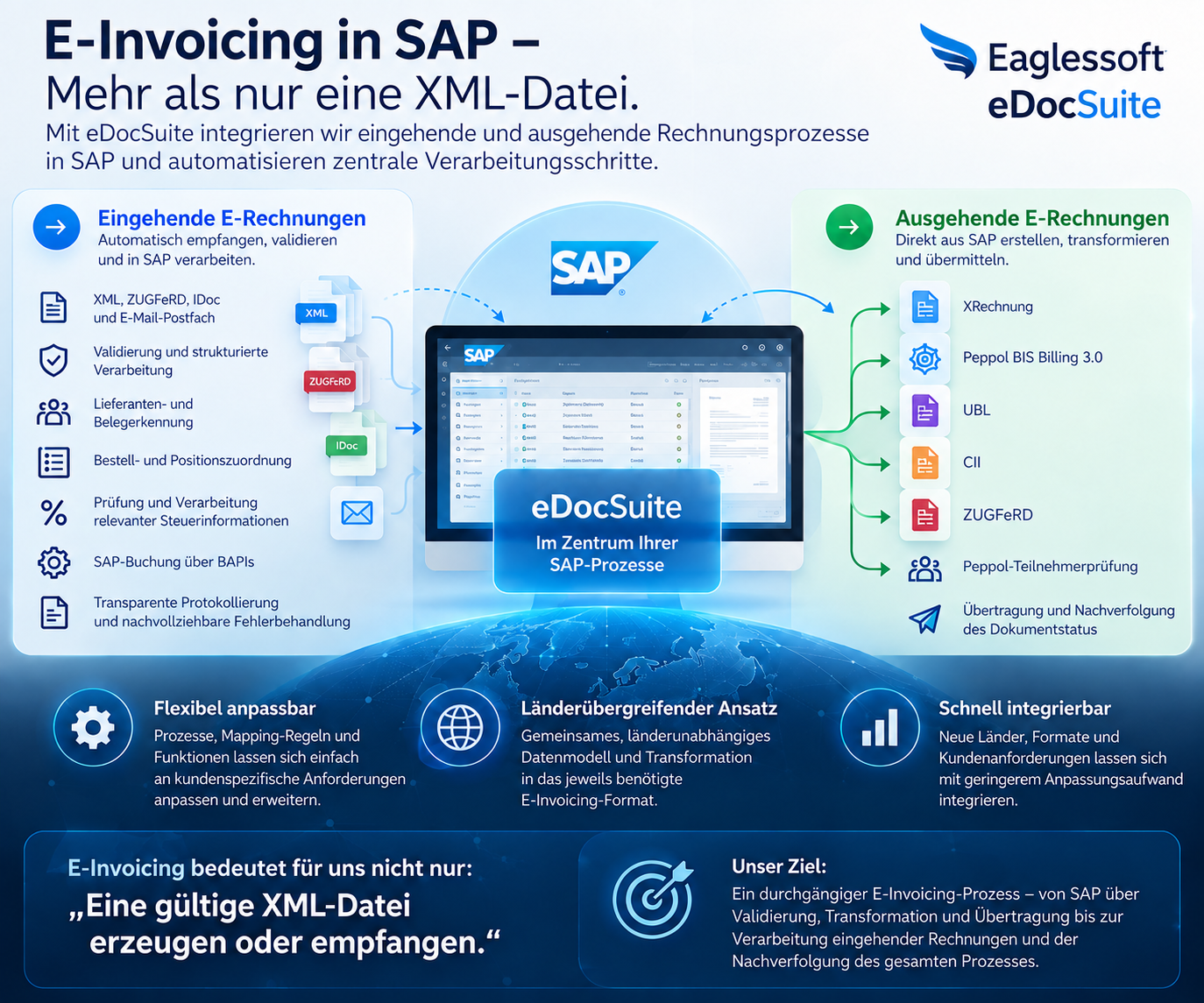
For incoming e-invoices, the process begins with receipt of the documents. eDocSuite supports, among other things, processing XML invoices, ZUGFeRD, IDocs and documents from an email inbox.
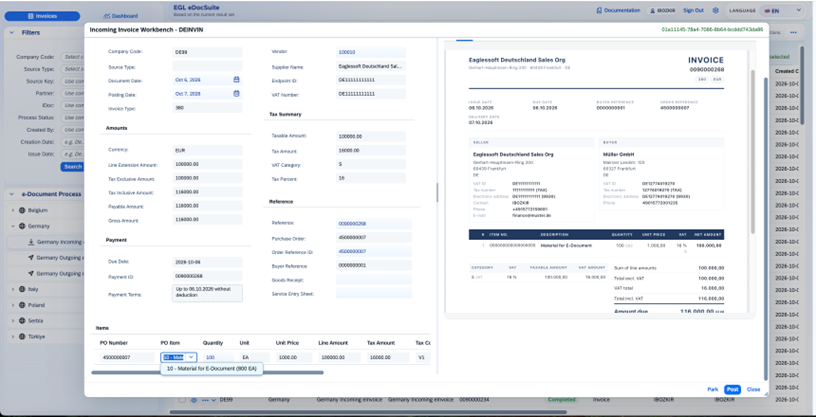
The invoice data is then validated, structured and matched to the relevant SAP data. This includes supplier and document identification, purchase-order and line-item matching, and checking and processing relevant tax information. BAPIs are used for SAP posting.
An example workflow: an invoice arrives as an XML attachment in an email inbox. Its data is extracted and validated. The supplier and corresponding purchase order are then identified, and the invoice lines are matched. Once the prerequisites for further processing are met, posting can take place through a SAP BAPI.
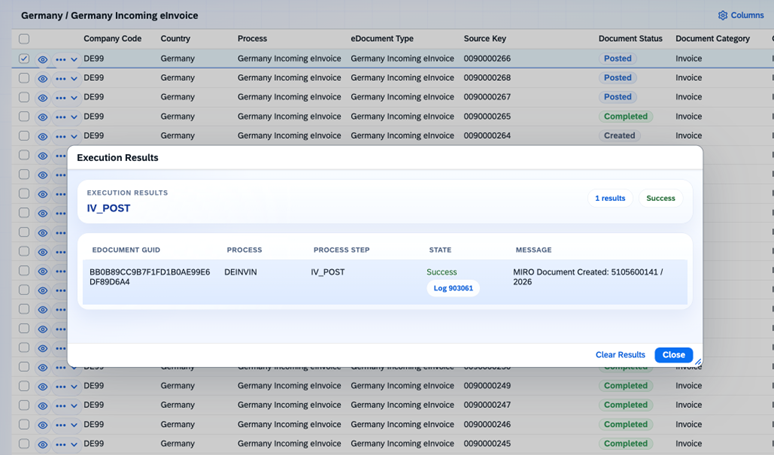
Logging makes both successful processing steps and errors traceable. Employees can see whether posting completed successfully or where clarification is needed.
Outgoing invoices: from SAP to the required target format
In the outgoing process, invoice data is taken from existing SAP processes, transferred into the common data model and then prepared for the required target format.
eDocSuite supports, among other things, XRechnung, Peppol BIS Billing 3.0 and ZUGFeRD, as well as processing the XML syntaxes UBL and CII.
Functions are also available for checking Peppol participants, transmission and tracking document status.
This transparency is essential for operations: creating a document alone does not show whether it was transmitted successfully. Only the traceable connection between creation, checks, transmission and status information provides a reliable overview.
Flexibility for international and customer-specific requirements
Adaptability was an important focus of our development. Even when companies use the same invoice formats, their internal workflows can differ considerably.
We therefore designed eDocSuite so that processes, mapping rules and functions can be adapted and extended to meet customer-specific requirements.
The common data model and extensible rules provide the foundation for adding further countries, formats and customer requirements with less adaptation effort. The global e-invoicing approach can thus be expanded gradually to cover additional local requirements.
Global e-invoicing as an integrated business process
For us, e-invoicing encompasses the entire processing chain: from providing SAP data through validation and transformation to transmission, processing incoming invoices and tracking status.
With eDocSuite, we connect these steps into a globally oriented, SAP-integrated e-invoicing solution. Incoming and outgoing invoices become a consistently traceable part of daily SAP processes.