

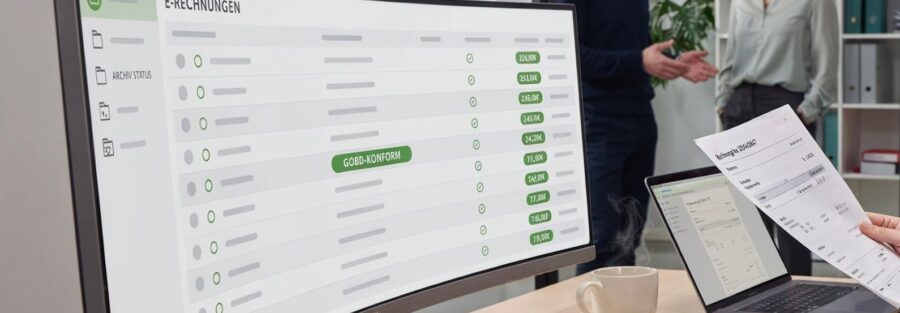
GoBD-compliant retention of e-invoices: obligations, periods and practical controls
Electronic invoice retention is a process involving data, controls, availability and documentation. Keeping a printed copy is not a substitute for retaining the required structured electronic data. At the same time, compliance should not be reduced to a storage-product label or an unsupported rule that every document must always be kept for ten years.
Key points
- Keep the relevant structured data intact, complete and machine-processable.
- German invoice retention is generally eight years, with special rules and extensions possible.
- A hybrid invoice’s visual component may also need retention if it includes additional or different tax-relevant information.
- Document the actual processing and control environment.
- Ensure retrieval, readability, protection and appropriate access throughout the period.
What GoBD principles address
The framework concerns traceability and verifiability, completeness, correctness, timely recording, orderly storage and integrity. Business transactions should remain understandable, records should be findable, and changes should not silently replace the original evidence.
A correction process should preserve the relevant history. Restrict permissions, record changes, back up data and test restoration. Controls must fit the actual business and system design rather than being assumed from a vendor’s claim.
Structured and visual components
The 2025 changes to the tax administration’s GoBD guidance clarify that retaining the structured part of an e-invoice can be sufficient when the requirements are met. Additional retention of a human-readable component is needed where it contains additional or different information relevant to taxation, such as accounting annotations or relevant signature information.
Do not delete a PDF view blindly, and do not assume every hybrid invoice must always be duplicated in two separate archives. Identify the relevant content and keep the required evidence. Preserving the original hybrid container can be a practical way to avoid accidental loss, but the legal analysis concerns information and process, not duplication for its own sake.
Retention periods
| Document category | General German period |
|---|---|
| Invoices and relevant accounting vouchers | Generally eight years under the applicable rules |
| Accounting books, inventories and annual financial statements | Generally ten years |
| Other relevant commercial correspondence | Generally six years |
The start and end of a period depend on the relevant statutory provision and document. Ongoing tax proceedings, assessment periods and sector-specific rules can extend obligations. Regulated financial or insurance entities should check their special rules rather than adopting the general period without review.
Agree the retention schedule and deletion process with the responsible tax and compliance advisers. Do not use an arbitrary extra period as a substitute for a documented rule.
Preserve the required original
For XRechnung, the structured XML is central. For ZUGFeRD/Factur-X, preserve the required embedded structured data and any other tax-relevant information. Do not lose XML through printing, screenshots or conversion to an image.
Any permitted conversion must preserve the required content, readability, evaluability and evidence. Retain relevant verified enrichments where the rules require them. A viewer or search copy can support users without replacing the original record.
What is not a complete process?
A paper folder alone does not preserve an electronic original. A normal mailbox or shared folder without suitable permissions, logging, retrieval, backup and controls may leave important gaps. Retaining only an image while discarding structured data also undermines processing and evidence.
However, tax guidance distinguishes invoice-retention requirements from wider bookkeeping controls. Storing an invoice outside a product advertised as a GoBD archive does not automatically establish every possible tax violation. Assess the actual process and applicable duties instead of relying solely on labels.
Procedural documentation
Document the business context and relevant tax features, user procedures, technical systems and interfaces, and operating responsibilities. Explain how invoices enter, are checked, approved, posted, corrected, retained, exported and eventually deleted.
Include roles, access rights, incident handling, backups, changes to systems and controls. Keep documentation aligned with actual operation and preserve relevant versions. A generic template that does not describe your process is of limited value.
Access during a tax audit
The German framework provides forms of direct read-only access, indirect evaluation by the business and provision of data to the authority. The applicable rights, scope and technical arrangements need to be supported as required; do not assume one informal PDF export always replaces every audit-access obligation.
Plan machine-processable exports, relevant master and transaction data, explanation of fields and the ability to retrieve historical records. Cloud hosting and foreign infrastructure do not remove obligations to provide lawful access. Check additional location and outsourcing requirements where applicable.
Practical checklist
- Are the required structured originals preserved unchanged?
- Is additional tax-relevant information identified and retained?
- Can records be found, displayed and evaluated throughout the period?
- Are access, changes, deletion and corrections controlled?
- Are backups and restoration tested?
- Does documentation describe the actual process?
- Can required audit data and access be provided?
- Are retention periods, exceptions and deletion approvals documented?
WORM storage, versioning and audit logs can contribute, but no single technology answers every point automatically.
Frequently asked questions
Is a printed e-invoice enough?
No. It does not replace the required electronic structured data.
Must the visual PDF always be kept separately?
Not in every case. Determine whether it contains additional or different tax-relevant information and preserve what the rules require. Avoid losing information through a blanket deletion policy.
Does an archive certificate guarantee my compliance?
No. Certification scope, configuration, operations and your responsibilities all matter.
Does every invoice have a ten-year period?
No. The general invoice period is eight years, while other document categories, special rules and extensions can differ.
Conclusion and next step
Good retention combines complete data, controlled change, reliable retrieval and documented responsibilities. Include it in the invoice workflow from the start rather than treating it as a final storage task.
Book a demo with Eaglessoft to discuss integration and retention requirements. This is general information; confirm the rules for your circumstances. The official 2025 GoBD amendment provides the source guidance.