
What is Peppol? A clear guide to the e-invoicing network
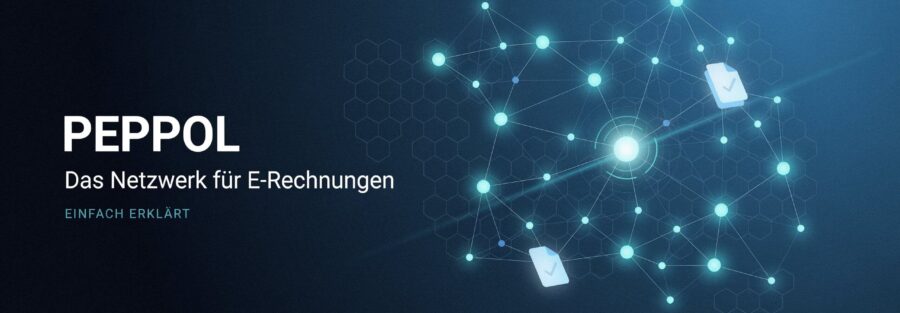
Peppol appears frequently in discussions about Germany’s e-invoicing reform. It is an exchange framework and network infrastructure for supported business documents, not one software product, a single supplier or a universal invoice portal.
This guide explains the network, Access Points, invoice formats and SAP integration, while keeping legal obligations separate from the choice of delivery channel.
What Peppol means
The name comes from Pan-European Public Procurement OnLine. The original European procurement project developed into an international framework governed by OpenPeppol and relevant Peppol Authorities.
Supported profiles can cover invoices, credit notes, orders, catalogues and other business documents. Actual exchange depends on the sender’s and recipient’s capabilities. Peppol generally works behind the business interface; your own provider may offer a portal, but the network itself is not one shared login service.
Why it matters in Germany
| Period | German domestic B2B position for relevant transactions |
|---|---|
| From January 2025 | Readiness to receive structured e-invoices |
| Through December 2026 | General issuing transition provisions |
| 2027 | Wider issuing requirement above the €800,000 prior-year threshold; extension generally available at or below it |
| From January 2028 | Wider structured issuing requirement, subject to exemptions |
| From July 2030 | ViDA digital reporting for relevant intra-EU B2B transactions |
An ordinary PDF is not a structured e-invoice. Transition provisions can still allow other invoice types; paper and unstructured electronic files have different consent conditions.
The tax rules do not prescribe Peppol as the only delivery channel for all businesses. Email can carry structured invoices where appropriate, and public-sector recipients have their own submission instructions. Peppol is useful for supported automated exchanges, not a universal legal requirement.
The four-corner model
The sender uses its own Access Point. That Access Point exchanges with the recipient’s Access Point, which delivers to the recipient’s system. These are the four corners: sender, sending provider, receiving provider and recipient.
A single connection can reach other registered participants with compatible profiles. It does not guarantee delivery to every organisation or replace every national reporting platform.
SML helps locate the recipient’s SMP. SMP publishes supported document and process profiles and endpoints. The participant identifier combines a scheme and value; a public buyer’s Leitweg-ID as an invoice reference has a different role. The public Directory is helpful for search but does not replace technical discovery.
AS4 provides certificate-based message security between Access Points and technical receipts. These receipts are not a guarantee of commercial approval or payment, and network security does not eliminate fraud or internal system risks.
What an Access Point does
An Access Point is the gateway to the supported network exchange. It discovers the receiving endpoint, sends or receives messages and handles technical statuses under the applicable rules.
Validation, conversion, ERP mapping and retention may be included or contracted separately. Verify the operator’s certification, supported profiles, onboarding checks, service levels and responsibilities. Do not assume every customer can be registered in minutes or that all business information is automatically verified for every purpose.
Learn more about our Peppol Access Point and SMP services.
Invoice formats are separate from transport
| Format | Structure | Typical use |
|---|---|---|
| XRechnung | Structured XML with German rules | Supported public-sector and business exchange |
| ZUGFeRD / Factur-X | PDF/A-3 and embedded XML in suitable profiles | Visual and automated workflows |
| Peppol BIS Billing 3.0 | UBL with profile rules | Supported Peppol invoice exchange |
EN 16931 provides a semantic foundation. A file being compliant with that standard does not mean every Peppol process accepts it unchanged. Check the actual document identifier, process profile, syntax and national rules. A hybrid PDF is not automatically a supported network payload.
Remember: the format describes invoice data; the network describes exchange. Neither one alone completes the accounting process.
Peppol and SAP
SAP Document and Reporting Compliance can support electronic document scenarios, depending on product, release, licence and country. Backend eDocument functions can work with cloud exchange services and monitoring applications. Add-ons and external integration services are also options for a defined scope.
A typical outgoing process creates the SAP document, maps and validates structured data, transmits through the configured service and returns statuses. Incoming processes also require supplier checks, matching, approval, posting and retention. Confirm the exact architecture instead of assuming one connector fits every SAP ERP and cloud deployment.
Eaglessoft can help assess the connection and operational workflow for your landscape.
Benefits and practical limits
- Reach: One provider connection for compatible registered partners.
- Data quality: Less retyping with integrated validation and processing.
- Speed: Automated exchange and status visibility.
- Security: Defined transport controls and responsibilities.
- Adaptability: A foundation for supported future national and reporting scenarios.
Benefits depend on implementation. A developing five-corner reporting model does not mean tax authorities automatically have unrestricted access to every Peppol invoice.
Getting started in five steps
- Select a suitable certified provider and confirm profiles and countries.
- Provide and verify company and identifier information.
- Register receiving capabilities where needed and test discovery.
- Connect the accounting or ERP system with validation and exception handling.
- Test exchange with partners, then monitor the live process.
SAP customers should assess DRC and alternative supported integration options. Smaller systems may use an API or portal. Choose according to workflow, volume and responsibility rather than assuming one software route is mandatory.
Frequently asked questions
Is Peppol mandatory in Germany?
Not as the universal channel for the domestic B2B tax mandate. Check public-sector and partner-specific instructions separately.
What does it cost?
Pricing depends on provider, volume, integration, support and storage. Compare total costs and the services actually included.
Is a PDF an e-invoice?
An ordinary PDF is not a structured e-invoice. A suitable hybrid file with embedded structured data is different.
Can I exchange internationally?
Yes, where registered capabilities and country rules support the required process. One connection is not a promise of universal coverage.
Is XRechnung the same as Peppol?
No. XRechnung is an invoice specification; Peppol is an exchange framework that can support appropriate document profiles.
Next step
Book a demo with Eaglessoft to plan connectivity, formats and processing together. This article is general information; legal and technical rules can change.